
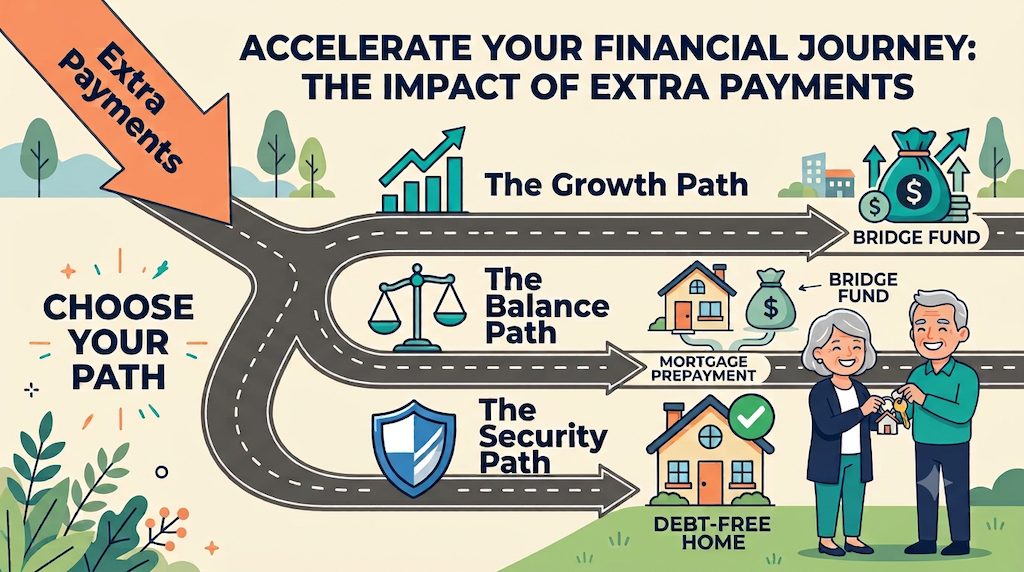
For Part 1 — see “Should I Pay Off My House? (Or Let a “Bridge Fund” Do It For Me?)”
Last time, we discussed the idea of paying off your house early and whether your age and the size of your retirement fund might suggest a Bridge Fund as an alternative. I left you with a teaser: the higher your mortgage rate, the riskier a Bridge Fund approach becomes.
So where is the cutoff? I think it will surprise you. A 3% pandemic-era mortgage rate behaves very differently in this scenario than a 6.25% mortgage rate. Let’s look at the numbers, map out the safety margins, and explore the tipping point where the math shifts.
📌 The Bottom Line
While the mathematical tipping point to invest your extra cash instead of paying down a mortgage is 8.60%, the real-world, risk-adjusted tipping point is between 5.50% and 6.00%. If your mortgage rate is below 4%, the Bridge Fund strategy remains highly advantageous; if it’s above 5.5%, direct principal payments are the superior path. Below, I break down the hidden tax drag that moves that tipping point down so far.
The Core Risk: Mortgage Rates vs. Market Volatility
If we look at the historical stock market average return of 10%, it seems like a no-brainer: as long as your mortgage rate is below 10%, you’ll come out ahead by investing in a Bridge Fund.
BEWARE! That can be incredibly deceiving. (That reminds me of a t-shirt I once saw that said, “Be Aware and Be Alert! The world needs more wares and lerts!” 😆 But I digress.)
The stock market does not return a smooth 10% each year—that is an average. In the real world, you have to deal with three critical factors that eat away at your safety margin:
1. The Shrinking Spread
If you have a pandemic-era 3% mortgage rate, you have a massive 7% gap between your borrowing cost and a 10% market return. But if your mortgage rate is 6.25%, that spread shrinks to just 3.75%. A smaller spread leaves you with very little room for error when the market behaves unpredictably.
2. The Tax Drag Cuts Deep
When you pay down a mortgage, you get a guaranteed, 100% tax-free return equal to your interest rate.
Conversely, your mutual fund returns are fully taxable. If we account for long-term capital gains taxes (15% federal plus standard state income tax, totaling roughly 19.5% on your investment growth), your actual net investment return drops from a nominal 10% down to roughly 8.05% after-tax.
3. Risk vs. Reward
With a 6.25% mortgage, you are comparing a guaranteed, tax-free 6.25% return (paying down debt) against a volatile, after-tax 8.05% return (the stock market).
You would be taking on 100% of the market’s volatility—meaning you could face major down years right when you want to pay off the house—just to chase an un-guaranteed 1.8% premium. At 6.25%, the psychological peace of mind and the guaranteed savings of a direct principal paydown easily outweigh the tiny, taxed advantage of investing.
Direct Paydown vs. Bridge Fund: At a Glance
Here is how the two strategies stack up across different interest rate environments, assuming a historical 10% market return and standard tax drag:
→ Below 4.00% Mortgage Rate: Invest (Bridge Fund)
- The Strategy: Put your extra cash into your investment/bridge fund instead of the house.
- The Reasoning: There is a massive, highly favorable spread between your low borrowing cost and historical market returns. Keep the cheap debt.
→ 4.00% to 5.50% Mortgage Rate: The Hybrid Approach
- The Strategy: Split the difference. Put some extra toward principal, and some toward your investments.
- The Reasoning: This is a gray area where a balanced approach offers the best mix of psychological progress and wealth building.
→ Above 5.50% Mortgage Rate: Direct Principal Payments
- The Strategy: Send every extra dollar straight to your mortgage principal.
- The Reasoning: The guaranteed, 100% tax-free return of shedding this high-interest debt easily outweighs the volatile, taxed returns of the stock market.
Finding Your Personal Tipping Point
Mathematically, the raw “tipping point” where the two strategies perfectly tie is a mortgage rate of 8.60% (assuming a 10% market return and a combined ~19.5% capital gains tax drag).
However, because of risk, the practical tipping point happens much sooner—usually between 5.5% and 6.0%.
Why risk money in the stock market for a volatile 8% after-tax return when you can get a guaranteed, tax-free 5.5% to 6% return by shedding debt? To decide where your personal threshold lies, ask yourself what “risk premium” you require to choose the stock market over a sure thing.
What’s Next?
We’ve covered the first major green light factor—the mortgage interest rate—to help you identify your personal tipping point. But the rate is only one piece of the puzzle. We still have three more green light factors to explore: your personal tax bracket, cash flow liquidity, and age.
Subscribe to the NumCrunch newsletter so you don’t miss Part 3!