
Every single week, we’re faced with some version of the same choice.
You’re standing in the aisle at the home improvement store, or scrolling through pages of options online, looking at two versions of the exact same item. One of them is cheap—dirt cheap. The other one makes you wince a little bit when you look at the price tag.
So, what do you do? Do you save the cash today and buy the budget version, or do you pony up for the quality name brand?
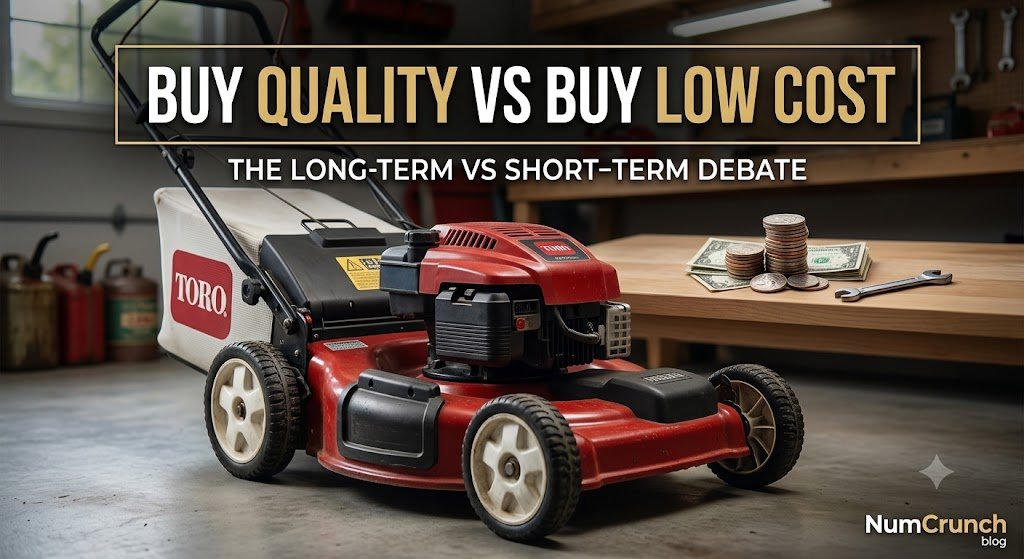
When we moved into our house twenty-four years ago, I found myself in this exact spot. I needed a lawnmower. I didn’t want to throw money away, but I also didn’t want something that would fall apart in two summers. I ended up choosing a solid, mid-tier Toro. It wasn’t the top-of-the-line professional rig, but it certainly wasn’t the cheapest bargain-bin option either. It cost maybe $100 to $150 more than the budget models.
Nearly two and a half decades later? That same mower is sitting in my garage, and it still starts up on the first pull.
Let’s break down the math on why that happened, and how you can make the right call on your own purchases.
The Short-Term vs. Long-Term Reality
If you only look at your bank account today, low cost wins every time. It keeps cash in your pocket right now. If things are tight and you’re managing a strict monthly budget, buying the cheaper option gets the immediate job done without putting you in a hole. There is no shame in that.
But if you look at the long-term math, quality almost always wins. If you buy a $150 lawnmower that dies every four years, you’re going to spend $900 over the next twenty-four years replacing it. By spending just a little more upfront for quality, you actually save hundreds of dollars over time. Because my Toro is still humming along, I’ve been able to redirect $400 to $600 toward other things I’d much rather spend money on.
The Secret Weapon: Delayed Gratification
Now, the biggest pushback to the “buy quality” argument is obvious: “What if I don’t have the extra $150 right now?” Unless you are facing a genuine, flat-out emergency, the answer is a classic piece of advice that has gone out of style: self-denial. In a world built on one-click ordering and “buy now, pay later” buttons, we’ve been conditioned to think that wanting something means we need to own it by Thursday. But if you can practice a little bit of sacrifice and wait until you’ve actually saved up the cash, you unlock two massive financial advantages:
- You buy the higher quality item. Instead of settling for the cheap version that you’ll have to replace in a year, waiting allows you to pool enough cash to buy the version that lasts.
- You completely bypass the credit trap. When you buy on credit because you “need it now,” the interest charges quietly eat away at any value you thought you were getting. Saving up means you own it outright on day one, with zero interest dragging you down.
The Golden Rule: Maintenance is Non-Negotiable
Once you’ve made the purchase, it’s not Done And Done. Here is the secret they don’t print on the box: Buying quality only works if you take care of it. My mower didn’t last 24 years by magic. It lasted because I took care of it. Over the years, I’ve paid for a few tune-ups, changed the oil, and sharpened the blades.
If you buy a high-quality item but treat it like garbage, you’re just throwing expensive garbage away. Budgeting a few dollars and a little bit of time for routine maintenance is what actually unlocks the long-term savings of a quality purchase.
When is it Actually Smarter to Buy Cheap?
You can’t buy the premium version of everything. If you try to buy top-tier luxury items for every corner of your life, you’ll go broke. You have to pick your battles.
Here are the factors that tell you it’s perfectly okay to go with the lower-cost option:
- The Frequency Factor: Are you going to use this tool every single weekend, or do you just need to fix one specific pipe under the bathroom sink this afternoon? If it’s a one-time job, buy the cheap tool. If it’s a staple of your routine, buy the brand name.
- The “Testing the Waters” Factor: If your kid wants to try out a new hobby, don’t go out and buy a top-of-the-line instrument or sports gear on day one. Start with a budget version. If they stick with it past six months, then you upgrade them to a quality reward.
- The “Net Cost” Clothing Factor: Don’t fall into the ultra-cheap clothing trap. Bottom-barrel fabric shrinks, fades, and looks like a rag after three washes—which just triggers the urge to go right back out and shop for replacements. Instead, buy solid, mid-to-high quality within your budget so it looks nice longer. Even better? Leverage today’s secondhand market. Buying a quality brand gently used—or reselling your own quality gear when the kids grow out of it—means you’re maximizing the life of every single dollar.
The Bottom Line
You don’t need to run every purchase entirely into the ground before you upgrade, but you should buy things with the intention that they could last.
Next time you’re debating between cheap and quality, don’t just look at the price tag at the register. Ask yourself: How often will I use this? Am I willing to wait a month or three to save up for the better version? And what else could I do with the money I’ll save by not replacing this in three years?
Find that sweet spot in the middle—the place where real value lives—and let your money go to work for you.