
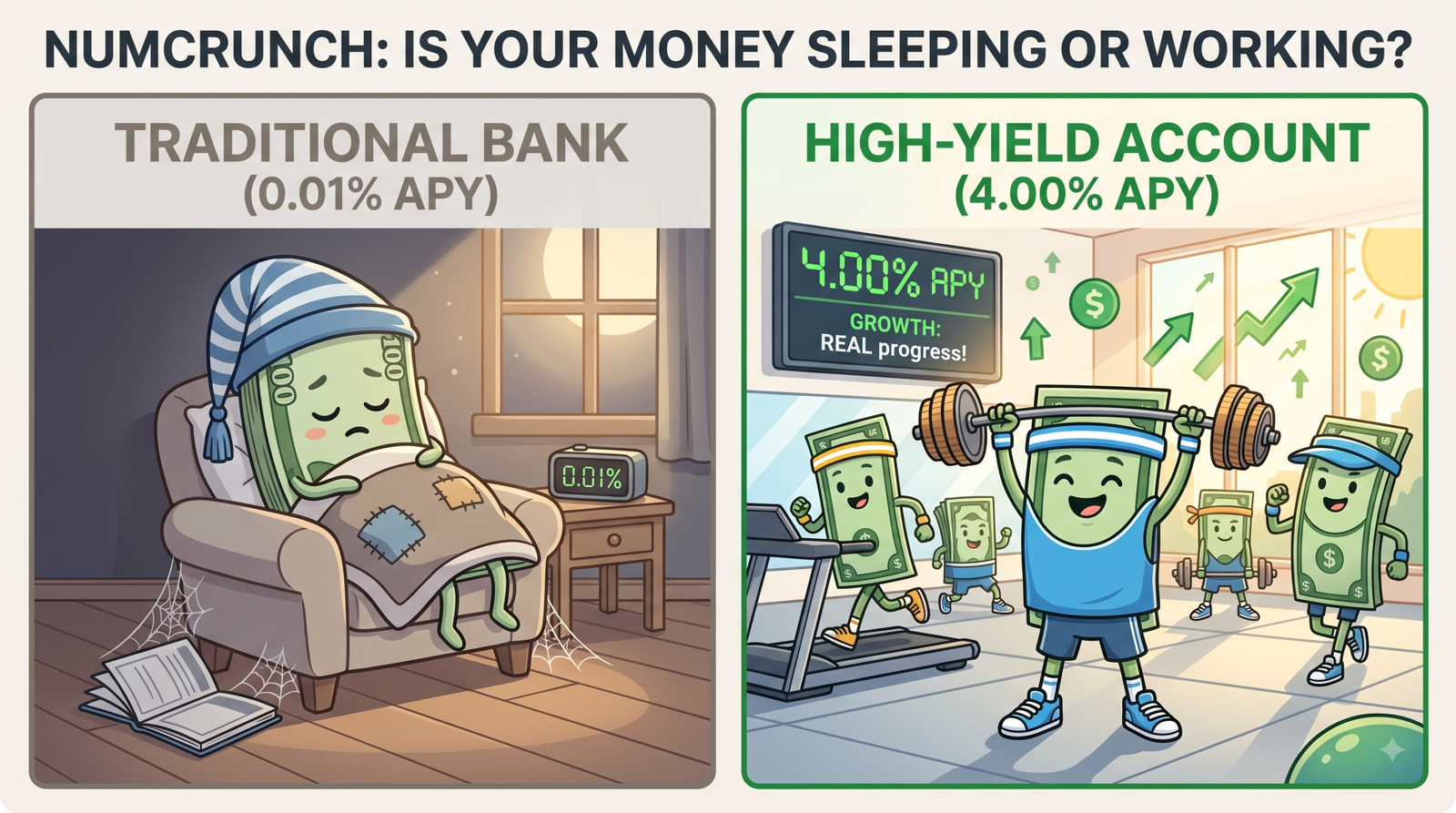
If you opened a savings account at your local big bank ten years ago and haven’t touched it since, I have news for you: Your money is falling asleep on the job.
Most traditional brick-and-mortar savings accounts pay around 0.01% to 0.05% APY. That’s not a typo. If you leave $10,000 in one of those accounts for an entire year, the bank generously hands you back roughly $1.00 in interest.
Meanwhile, high-yield savings accounts (HYSAs) are sitting right around 3.80% to 4.15% APY.
Let’s do some quick dad-math:
- Traditional Savings ($10,000 at 0.01%): $1.00 / year
- High-Yield Savings ($10,000 at 4.00%): $400.00 / year
That $399 difference isn’t pocket change. That’s two full weeks of family groceries or even a monthly car payment—paid for entirely by bank interest for about 10 minutes of initial effort.
Here is a reworked Math vs. Mindset section focused on momentum, progress, and behavioral motivation:
1. Math vs. Mindset: Why Real Returns Drive Better Habits
It’s easy to tell yourself, “I’ll move the money later when I have a bigger chunk to make it worth it.” But waiting misses the real power of a High-Yield Savings Account: momentum.
When your savings account pays a lousy 0.01%, it feels dead on arrival. You put $5,000 away, look at it six months later, and see $5,000.25. When an account feels stagnant, your brain stops treating it as a growing asset and starts viewing it as a pool of idle cash waiting to be spent on the next house project or impulse purchase.
A high-yield account changes the psychology entirely:
- Visible Progress: Watching your balance grow by $30, $40, or $50+ every single month strictly from interest creates an immediate feedback loop. You actually see your effort paying off in real time.
- The “Protect the Streak” Effect: Once you watch your money earn real, passive returns, you naturally want to guard it. You become far less likely to raid the account for non-emergencies because doing so directly slows down your earning momentum.
- Fuel to Add More: Real growth is addictive in the best way possible. When you see $400 in free money land in your account over the course of a year, your mindset shifts from “How much cash do I have left to spend?” to “How much faster can I build this up?”
Ultimately, an HYSA isn’t just about picking up extra interest—it’s a tool that trains you to hang onto your cash, protect your family’s shield, and actively look for ways to increase it.
2. Choosing the Right Spot for Your Emergency Stash
Your emergency fund needs to be two things: 100% safe and liquid (accessible when real life happens). You shouldn’t risk this money in the stock market, but you shouldn’t let inflation eat it alive in a standard savings account either.
Make sure any institution you pick is FDIC-insured (for banks) or NCUA-insured (for credit unions). This guarantees your deposits up to $250,000 per institution.
Here are a few top-tier online HYSAs operating in today’s market:
- Forbright Bank (~4.15% APY): Industry-leading yield with a $0 minimum opening deposit.
- CIT Bank (~4.10% APY): Great yield on higher balances ($100 minimum deposit required).
- Marcus by Goldman Sachs (~3.90%–4.00% APY): No minimums, clean mobile interface, and extremely reliable customer experience.
- Ally Bank (~3.85%–4.00% APY): Includes “Savings Buckets” to easily organize sub-goals within a single account.
- Capital One 360 (~3.85%–4.00% APY): Great hybrid option if you occasionally want physical branch or fee-free ATM access.
(Note: Rates in the HYSA space are variable and move with Federal Reserve benchmark decisions, but top online banks consistently outpace traditional brick-and-mortar branches.)
3. What About High-Yield Checking & All-In-One Banks?
A common question I get is: “Can I just get a High-Yield Checking account instead?”
High-yield checking accounts do exist—typically offering 1.00% to 2.75% APY—and they issue standard Visa or Mastercard debit cards accepted everywhere. However, top-tier checking yields usually require strict rules, like making 10–15 debit card purchases a month or maintaining active direct deposits.
The “All-in-One” Contender: SoFi
If you’ve heard people raving about SoFi, there’s a reason—it’s a great platform, but it works differently than a standalone savings account.
SoFi opens both checking and savings under one roof.
- The Catch: To unlock their top savings APY (currently ~3.80%–4.00%+ with promos), you must set up an eligible direct deposit. Without direct deposit, the savings rate drops significantly.
- The Verdict: If you want to completely overhaul your banking and move away from traditional banks entirely, SoFi’s “Vaults” and bundled checking/savings are fantastic. But if you just want an isolated, hassle-free parking spot for your emergency stash without altering your payroll setup, stick to a standalone HYSA like Marcus or Ally.
4. Practical Logistics: Access, Transfers, and Apps
ATM Access on Savings Accounts?
Most dedicated HYSAs do not give you an ATM debit card—and that’s a feature, not a flaw. You don’t want instant ATM access to your emergency reserve when you’re standing in line at a store. Removing debit card access creates just enough friction to protect you from impulse buys.
Opening an Account
You do not need to call anyone, make an appointment, or sign paperwork in person. You can open an online HYSA from your couch in under 10 minutes. All you need is:
- Your Social Security Number and driver’s license.
- Your home address.
- The routing and account numbers for your current checking account to fund the transfer.
Auto-Transfers & Budgeting Apps
- Paycheck Automation: You can split your payroll direct deposit so 90% goes to checking for daily bills and 10% routes straight into your HYSA.
- Bank-to-Bank ACH: Standard transfers between your main bank and an external HYSA take 1 to 3 business days—the perfect buffer for true emergency use.
- Budget Software Compatibility: Almost every major online bank links seamlessly via Plaid/MX to budgeting tools like EveryDollar, Copilot, and Monarch, allowing you to monitor your net worth without mixing your cash together.
The Dad Advice Bottom Line
Don’t let perfection paralysis keep your money stuck in a 0.01% account. You don’t need to time-match the market or hunt down every fraction of a percent.
Your action step this week: Pick a solid online bank, take 10 minutes to open an account, and transfer your emergency fund over. Put those extra hundreds of dollars back where they belong—in your family’s budget, not the bank’s bottom line.
Disclaimer: Look, I’m your internet Dad, not your personal financial advisor, certified public accountant, or family law attorney. The information in this blog post is for educational, entertainment, and general informational purposes only. It should not be taken as legal or professional financial advice. Because laws vary wildly by state and individual situations get messy fast, always consult with a qualified professional before making major life, financial, or legal decisions.
In the spirit of complete transparency, while the financial lessons and editorial direction of this post are entirely mine, the final text and accompanying artwork were crafted with the guidance and use of artificial intelligence. Play it smart, protect your assets, and keep crunching those numbers safely!