
If you’ve been reading Dad’s Money Tips for a while, you may recall my little humble brag in The “Buy Once, Cry Once” Debate about my 24-year-old lawnmower still going strong. Well, two weeks ago it wasn’t so strong anymore. And having just posted about it a few months earlier, I was determined to save it and fix it myself! Besides, I have several other things I’d rather spend $400-500 on instead of a new lawnmower! And thus began the adventure!
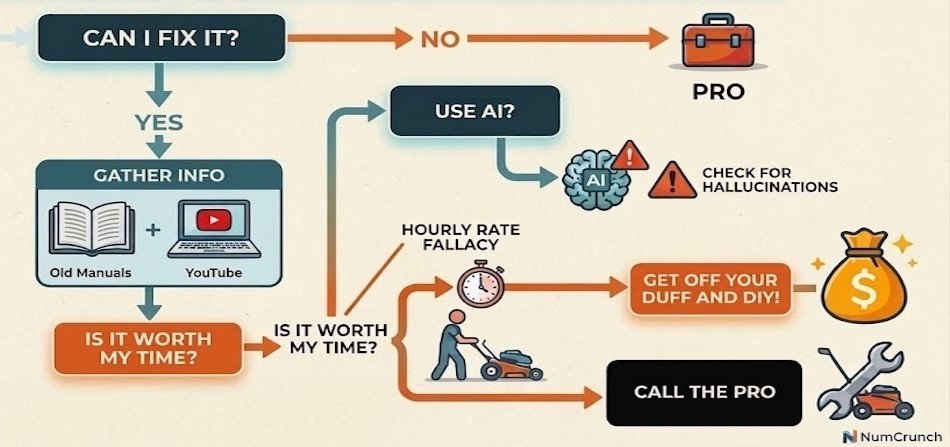
The DIY Flowchart: From “Can I?” to “Should I?”
This is a great area to explore when it comes to money. Can you fix or repair it yourself? And if so, is it worth it? When do you roll up your sleeves, and when do you call in a pro? Or do you only call a pro when you can’t do it yourself?
Let’s break ‘em down and see what comes out. First, it’s all a moot point if you can’t fix it yourself. Or is it? There are so many resources online these days, especially in what many call “YouTube University”. For some reason, someone has posted a video about how to fix or repair practically anything. It may have been posted 6 years ago and only has 128 views, but it’s out there. And it works! Truth be told, you won’t find a video for everything, but it sure feels like it sometimes. So the question isn’t so much, “Can I fix this myself?” as much as it is, “Am I prepared to find out and learn how to fix this myself?”
It’s like a flowchart. “Do I know how to fix this?” branches off into Yes and No paths. The No path then asks, “Am I ready to learn how?” and again, more Yes and No paths. The Yes path says, “Time for YouTube!” and the No path says, “Find a pro!” or a friend or family member or anyone but yourself.

Enter AI: Your Enthusiastic (and Blind) Assistant
Suppose you say Yes to learning how. Today there’s another option that really wasn’t available until just the past few years — Artificial Intelligence, or AI. ChatGPT, Gemini, Claude, Grok, and so many more seemingly all-knowing entities to which we can ask any question. A great resource, yes, but it’s truly just that: a resource. AI can get it wrong and often does. Let’s take my lawnmower repair, for instance.
The mower wouldn’t start, or it would start but not stay running. I noticed there’s a cable running from the pull-back handle down to the engine that engages the engine when the pull cord is pulled. It appeared to be dislodged from its bracket, so it didn’t stay taut once I started the mower. I think I’ve found the problem. So I fire up Gemini, add some pictures of the wonky cable, and, with its guidance, find and enter the mower model. I spent two hours trying to implement Gemini’s instructions on how to secure this cable. It acted like it knew exactly what the problem was, agreed my assessment was right, and even gave step-by-step instructions on how to fix it.
Ultimately, I turned to good ol’ YouTube and had my answer in 30 min. The problem? The metal casing for the cable was bent in a long curve. Gemini thought that’s how it was supposed to be and kept trying to fit the curved part into the bracket. The YouTube video? A 3-year-old video with 3000 views. I just needed to order a new $15 cable and spend 10 minutes replacing it. Done!
Now I’ve used AI for quite a few different things, even successfully on DIY. So I’m not disparaging it, just making sure you properly understand it. Did you know that because AI was trained on human behavior, it can sometimes act in human-like ways, such as pride and embarrassment? AI doesn’t feel pride or embarrassment, but it is trained to predict the next logical answer with total confidence. When it doesn’t actually know, it often ‘hallucinates’—sounding 100% certain while leading you completely astray. Just like my bent cable casing. My brother-in-law is a lawyer and he’s told me that there have been instances where attorneys have brought briefs to court that were generated by AI and included completely made-up references! The attorneys had simply trusted the AI and not fact-checked what it gave them. So go ahead and use AI. I do. Just understand its limitations and act accordingly.
The “What Is My Time Worth?” Fallacy
Now back to the flow chart! I can fix it or am willing to learn how to fix it. Is it worth my time? Some people believe that it’s always worth your time, that you should always do as much as you can whenever you can. And they are successful. They can do a lot and save a lot of money. Others ask themselves, “How much is my time worth?” and kinda miss the point. That is, they look at their full-time job and conclude their time is worth the same hourly rate, and if it’s going to take more time-money than the cost of calling someone, then it’s not worth it. But how is that missing the point?
Let’s say I’m a graphic designer (I’m not, but let’s say I am) making $85K per year. That’s $42.50/hour. If it takes 3 hours to do it myself, that’s like spending $127.50. But if someone else can fix it for $99, then I’m getting them to do it. Right? Well, maybe. If I’m just going to spend that time doomscrolling or watching Netflix, is it really the same as spending my hourly rate? Now if I had to take time off work to do it, or if I could be working on a side gig earning that rate, then it’s comparable. Otherwise, you can do it yourself, and save the money! That’s a win! That could be hundreds, if not thousands, each year that could be going towards other more important things or even into your investing accounts. For a more in-depth look at what that money could do, see last week’s post: Wealth Is NOT Only For Retirement. The distinction between unpaid evening downtime and billable hours is a mindset shift, but you can get there.
Victory Laps and Leaking Gas: The Real ROI
Remember the lawnmower? Turns out I wasn’t done. Oh, it started and ran, so my repairs were a good move. But I then noticed gas dripping out onto the mower deck. There was a split in the fuel line. I had already replaced the brake cable, changed the air filter, and changed the oil (all things I had to learn how to do, btw). So I wasn’t giving up now! With Gemini’s help, I identified and bought the right hose to use to replace the split fuel line (good job, AI!). But when I tried to follow its instructions on replacing the line, it didn’t account for the carburetor that was in the way (bad job, AI!). Luckily, with the help of YouTube and divine inspiration, I figured out a simpler approach and got the job done! Twenty-four-year-old mower still on the job! All told, I spent about $40 or so and maybe 4 hours. And I saved the $400-500 a new mower would’ve cost.
Maybe you don’t consider yourself a handy person and don’t have the confidence to engage in YouTube University. That’s alright. We all have different talents. But just as I would encourage a non-budgeter to learn more about money management, I’m going to give you a nudge to give yourself a little more credit. Start with something small and inexpensive. You may just surprise yourself and find a hidden talent!
——————————
Disclaimer: Look, I’m your internet Dad, not your personal financial advisor, certified public accountant, or family law attorney. The information in this blog post is for educational, entertainment, and general informational purposes only. It should not be taken as legal or professional financial advice. Because laws vary wildly by state and individual situations get messy fast, always consult with a qualified professional before making major life, financial, or legal decisions.
In the spirit of complete transparency, while the financial lessons and editorial direction of this post are entirely mine, the final text and accompanying artwork were crafted with the guidance and use of artificial intelligence. Play it smart, protect your assets, and keep crunching those numbers safely!