
The “Someday” Trap (And What About Right Now?)
For the longest time, I had this idea that other than a savings account for emergencies or large purchases, any other money saved was to go toward retirement. As I watched our retirement funds grow, I found myself looking forward to retirement when we could use that money. If we met our retirement planning goals, we should have a fairly nice life — once we retired.
But what about in the meantime? Yes, retirement is an absolute must as far as financial planning goes, but there are additional considerations to make, too. Just take the basic case of always wanting to pay cash for that next car, vacation, or home remodel. Sure, I can sock away so much every month, and I could even put it in a HYSA so it grows a little on its own while I build it up. If you’re not familiar with an HYSA (High Yield Savings Account), I recommend the Dad’s Money Tips post — HYSA: Why Your Emergency Fund Needs a High Yield Home.
Enter Mid-Term Investing (MTI)
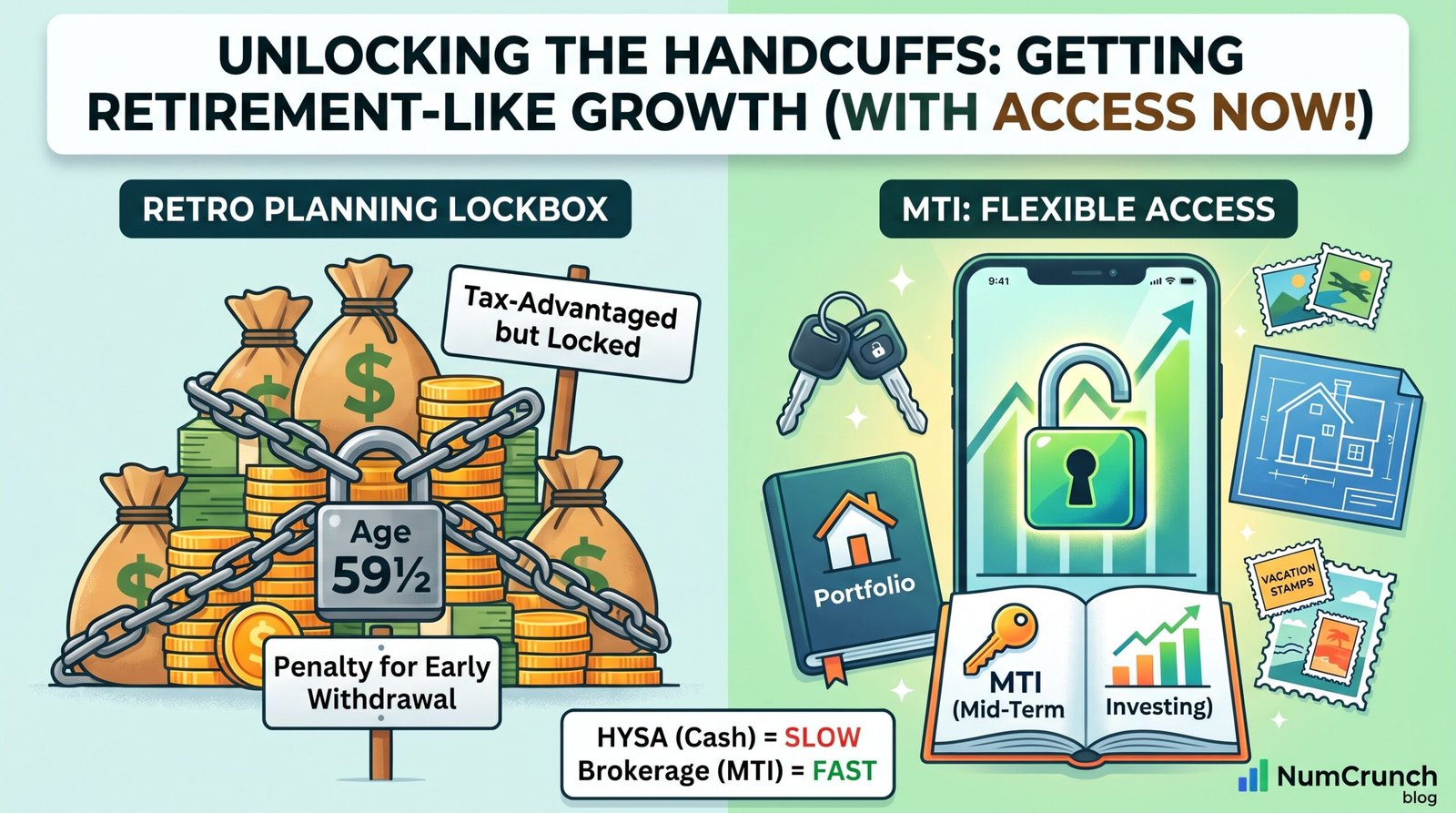
How about a better approach? Let me tell you about Mid-Term Investing, or MTI. Now, as you would assume, MTI falls right in between short-term and long-term investing. That HYSA I just mentioned is your short-term investing. Roth IRAs and 401(k)s are your long-term investing – which you can’t touch until you’re 59½ years old (scroll to the bottom for more info on exceptions). What we want is the growth benefits of long-term investing with the accessibility of short-term investing. That means we open and put money in a regular old investment account. You can do this through any one of many brokerage firms like Charles Schwab, or with a simple app like Robinhood.
What is Mid-Term Investing (MTI)?
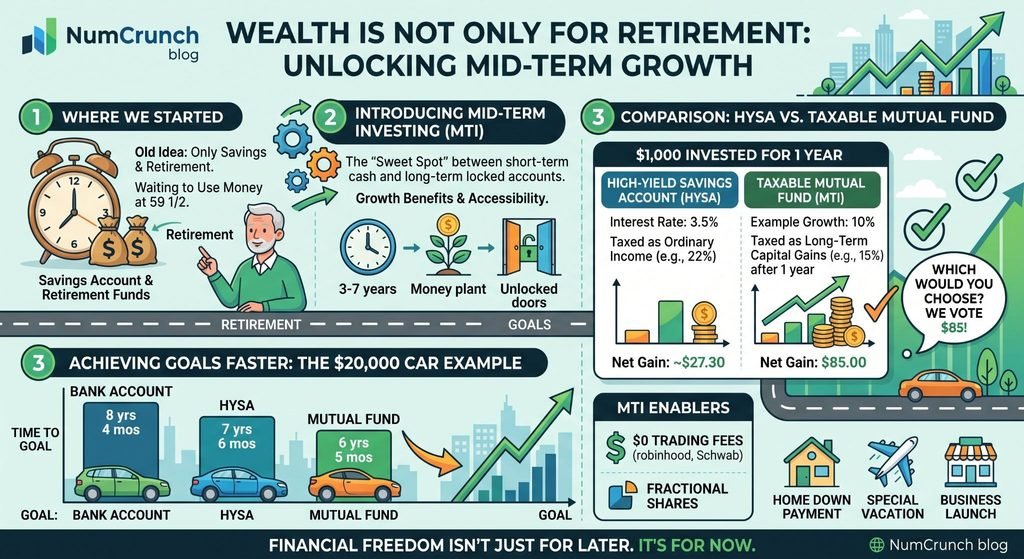
Mid-term investing is a strategy designed for financial goals roughly 3 to 7 years away. It bridges the gap between liquid cash accounts (like HYSAs) and locked retirement accounts (like 401(k)s and IRAs) by using standard, taxable brokerage accounts to achieve stock market growth with complete withdrawal flexibility.
The Tax Secret: Capital Gains vs. Ordinary Income
What gives IRAs and 401(k)s their superpower? Simple: stocks and mutual funds compounding over time.
Now, those retirement accounts also get special tax perks from Uncle Sam, which is why the government slaps handcuffs on them until you’re 59½. That’s the trade-off.
So the natural question is: Is it still worth investing in the market without the tax shelter?
Absolutely. In fact, taxable accounts have a little tax secret of their own that many people don’t realize.
When you earn interest in a regular savings account or an HYSA, the IRS treats that growth as ordinary income—the exact same rate you pay on your paycheck. And you have to pay taxes on that interest every single year, whether you pull the money out or not. That chips away at your compounding year after year.
Investments in a regular brokerage account work differently. As long as you hold an investment for at least one year before selling it, your profit is taxed at the long-term capital gains rate. For most everyday Americans, that rate is just 15% (and if your taxable household income is on the modest side, it might even be 0%!).
Even better: you don’t pay taxes on that growth until the day you actually sell the shares. Your gains get to sit there untouched, snowballing and compounding undisturbed until you’re ready to buy that car.
Let’s run the real numbers to see the difference.
The Real Math: $1,000 Over 1 Year
Say you park $1,000 in an HYSA earning a solid 3.5%:
- Your account earns $35.
- Taxed as ordinary income (let’s assume a 22% tax bracket), you hand over about $7.70 to the IRS.
- Your net in-pocket gain: ~$27.30.
Now, say you put that same $1,000 into a broad-market index fund or mutual fund averaging 10%:
- Your investment grows by $100.
- You hold it for over a year, so it qualifies for the 15% long-term capital gains rate. When you sell, taxes take $15.
- Your net in-pocket gain: $85.00.
Which would you rather put toward your next car: $27 or $85? I’m voting for the $85 every day of the week.
Yes, the IRS takes a small piece of the pie when you cash out, but the pie itself is so much bigger that you still walk away way ahead.
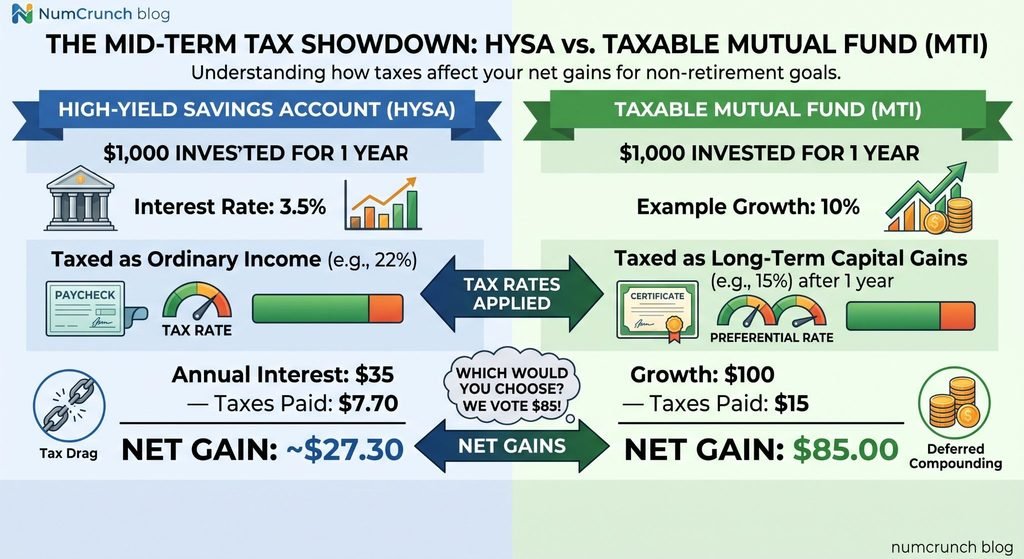
Alt text: Infographic comparing net returns of a High Yield Savings Account vs Taxable Mutual Fund after taxes on a $1,000 investment.
Caption: Comparing net returns: Why long-term capital gains tax rates give taxable brokerage accounts an edge over ordinary income tax rates on savings interest.
Putting It on Autopilot: Dollar-Cost Averaging
Just as with retirement investing, we use automated deposits. You can set up your account to draw the same amount from your bank account every paycheck. I like to set mine to the day after the paycheck hits just to make sure the money’s in there. Out of sight, out of mind. If it’s taken out right away and done automatically, you hardly miss it. A regular investment like this is called Dollar Cost Averaging (DCA). Some weeks the stock price will be low; other weeks it will be high. But if you’re putting in the same amount each time, it all averages out, and you make real progress.
Why It’s Easier (and Cheaper) Than Ever
Personally, I use Robinhood for my MTI. I was actually one of their early adopters. Did you know that before Robinhood came out with $0 trading fees, the industry standard was $5-10 per trade? They were the ones who forced the industry to drop trading fees, and that was just in the last decade. Before that, you’d pay the trade fee when you bought a stock and again when you sold it. For a $100 investment, that meant losing $10-20 right off the bat, requiring a 10-20% growth just to break even. The real bottom line was that small or casual investors really struggled.
But now things are different! Not only are there no trade fees, but there’s now what’s called Fractional Share Trading. That means you can buy $10 of a stock even if the share price is $200. You buy a fraction of a share. Before 2019, you pretty much always had to buy whole shares, which again was more difficult for small investors. Imagine wanting to invest in a certain company, but the stock price was $400. You had to save up before you could invest.
“Wait, Can’t I Just Tap My Retirement Early?”
Now, if you’re a savvy saver, you might be thinking: “Hold on a second. Aren’t there ways to pull money out of retirement accounts before age 59½ without getting clobbered by penalties?”
Fair point. There are a couple of well-known backdoors:
- The Roth IRA Contribution Loophole: With a Roth IRA, you can withdraw your contributions (the actual money you put in) at any time, for any reason, with zero penalties and zero taxes. The IRS already taxed that money when you earned it, so they let you take it back. But the growth—the compound interest and returns your money made—is locked up tight until retirement age. If you touch that growth early, Uncle Sam hits you with taxes plus a nasty 10% penalty.
- Special IRS Rules (like the Rule of 55 or 72(t)): There are narrow exceptions where you can tap certain retirement funds a few years early if you leave your job at age 55, or if you agree to take rigid, equal payments over several years.
So yes, workarounds exist. But here’s my take on why relying on them for mid-term goals is usually a bad idea:
First, paperwork and rules. If you pull contributions out of your Roth IRA, keeping track of your basis versus your earnings is just an extra headache come tax season.
Second, and more importantly: opportunity cost. Every single dollar you pull out of your Roth IRA is a dollar that permanently loses its tax-free compounding shield for your golden years. Once you take it out, you can’t just dump a big lump sum back in later to make up for it because of annual contribution limits.
The Bottom Line: Guilt-Free Spending
Why play gymnastics with your retirement nest egg just to buy a car or remodel a kitchen?
That’s the beauty of Mid-Term Investing in a regular brokerage account. There are no contribution caps, no withdrawal penalties, no tracking rules, and zero guilt about raiding your future retirement. It’s clean, flexible, and built specifically to be spent when you need it.
Frequently Asked Questions
- What is the typical time horizon for mid-term investing? 3 to 7 years. Less than 3 years belongs in cash/HYSA to avoid market dips; 7+ years can afford retirement-level volatility.
- Can you lose money in a mid-term investment account? Yes. Index funds fluctuate, which is why having at least a 3–5 year runway matters.
- What is the best type of account for mid-term investing? Standard individual taxable brokerage accounts with low or zero fees.
——————————
Disclaimer: Look, I’m your internet Dad, not your personal financial advisor, certified public accountant, or family law attorney. The information in this blog post is for educational, entertainment, and general informational purposes only. It should not be taken as legal or professional financial advice. Because laws vary wildly by state and individual situations get messy fast, always consult with a qualified professional before making major life, financial, or legal decisions.
In the spirit of complete transparency, while the financial lessons and editorial direction of this post are entirely mine, the final text and accompanying artwork were crafted with the guidance and use of artificial intelligence. Play it smart, protect your assets, and keep crunching those numbers safely!