
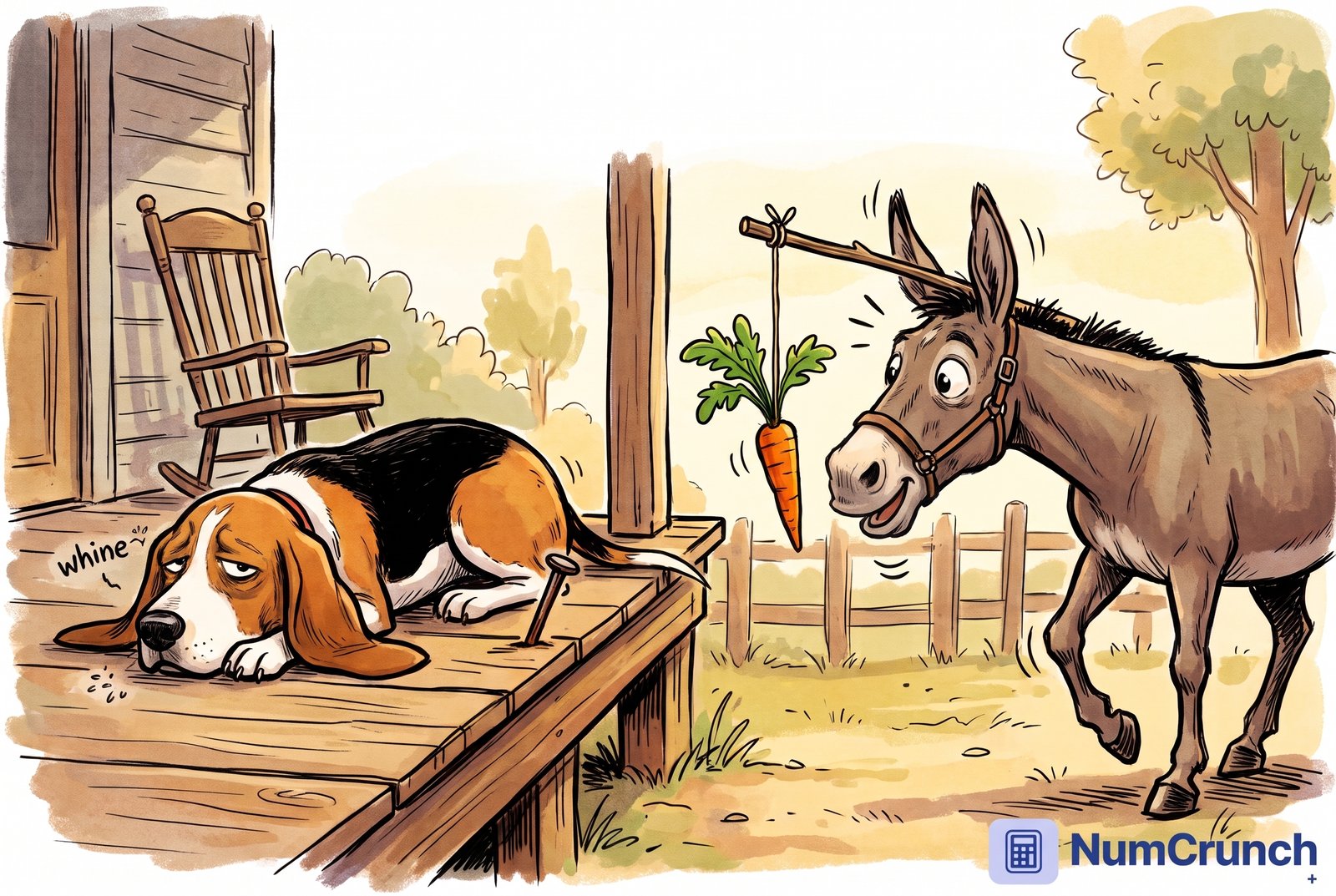
There’s the story of an old hound dog hanging out on the porch. It’s a beautiful day; the sun is warm, and he’s spread out for a nap. But there happens to be a nail sticking up that’s poking him. Nothing terrible, just annoying enough to prevent that nap. It’s too much effort to move, so he just deals with it, though he lets out a little whine from time to time. After a bit, he turns just the wrong way, and the nail gets him a bit too sharply. Now it’s time to move, and he lumbers over a couple of feet and plops back down. Soon he’s sound asleep.
How often are we like that old hound dog? Our situation isn’t what we want it to be, but making changes is too much trouble. So instead we whine and complain, and nothing changes. Inertia keeps us going down the same path. It’s only when something dramatic or painful enough happens that we finally take action! Was it really that much effort for the old dog to just move a couple of feet? Is it really that much effort to see some real change in our finances?
What motivates you the most? Ever hear of “the carrot or the stick”? That comes from way back when a farmer needed to get his stubborn old mule to move. He had the choice between dangling a carrot in front of the mule or smacking it with a stick. Are you more of a carrot person, motivated by reward? Or are you more of a stick person, having to be forced into moving to avoid a punishment or negative result?
For me, I’ve found that throughout my life there’s been plenty of both. I can get excited about a new venture or project that will improve our lives. I can also procrastinate with the best of them, even when I know the end result will be good. Way too many times I’ve put off something only to find out once I do it that it only took a few minutes. And I’m like, “Why was I putting that off for so long? This could’ve been done a long time ago if I’d just done it!”
Ask yourself what you’ve been whining about instead of applying a little effort. Is it setting up a budget? Maybe moving your savings to a HYSA? Filling out the paperwork to maximize your employer’s 401(k) match? What’s stopping you, and what would it take to break the inertia and get it done?
I’ve found a helpful little exercise that works pretty well — I first picture myself doing it. Weird, huh? But I swear it works! If I can simply visualize myself going through the actions to accomplish the task, there’s something about that that gets me to break through whatever’s holding me back. Often I do this the night before. I’ll think about what I need to get done and then think about what’s required to do it. And if I’ll walk myself through it, more often than not I get it done the next day. Sometimes I just need to picture myself starting, and that’s enough to do it. If I didn’t go through that the night before but still need to make it happen, I can still take just a few minutes to visualize myself doing it, and I can get right on it immediately after.
Why We Keep Putting Things Off
I think the biggest reason most of us stay stuck like that hound dog isn’t because we’re lazy. It’s just that the things bugging us aren’t quite painful enough yet.
Think about it this way: if your water heater springs a leak and floods the basement, you don’t sit on the couch debating whether you feel like dealing with it today. You jump up, turn off the water main, and get to work. It’s an emergency.
Money problems rarely start out as an emergency, though. Most of the time, they’re just a dull ache.
We do this with our savings. We leave money sitting in an old checking or savings account earning practically zero interest. It’s safe, it’s familiar, and nobody is banging on the door demanding anything. But every single month, we’re missing out on real money that a high-yield account could be earning on complete autopilot. Because it doesn’t hurt right now, we just roll over and keep napping.
Sometimes the Reward Is Just Too Far Away
On the flip side, we have the carrot. The problem in personal finance is that the carrot is almost always dangling way too far down the road.
Every financial book out there wants you to get excited about retirement thirty or forty years from now. They tell you that if you give up a few everyday conveniences today, you’ll be sitting pretty on a beach when you’re seventy. And look, saving for retirement is huge—I talk about that all the time. But let’s be honest: a reward that’s thirty years away does not do much to get a stubborn person moving on a random Tuesday.
If you’re someone who runs on rewards, you have to bring that carrot a whole lot closer to today.
Let’s say you’ve been meaning to go through all those recurring charges on your credit card. You finally sit down, look through the last couple of statements, and realize you’re paying $35 or $40 a month for gym memberships you forgot about or streaming apps you haven’t opened since last winter. That’s around $400 or $500 a year back in your pocket.
Now, instead of just letting that money disappear back into the general checking account where you won’t even notice it, give yourself something to look forward to. Put that cash straight toward a weekend road trip with the family, or toward a project around the house you’ve been dying to tackle, or even just a nice dinner out this Friday. When you connect a boring half-hour chore with something fun you actually get to enjoy soon, getting off the porch suddenly makes a lot more sense.
What Actually Works for You?
I think most of us probably lean a little more toward one than the other. It helps to figure out which one works better for you.
If you’re more of a stick person, you probably know it. You’re the kind of person who packs the suitcase an hour before leaving for the airport, or files your taxes on April 14th. You just don’t move until you feel the deadline breathing down your neck.
For me, when I find myself dragging my feet like that, what finally moves the needle is figuring out what my procrastination is actually costing me in real terms. I don’t just say, “I should probably move my emergency savings into a better account sometime.” I do the quick math. If I’ve got $10,000 sitting in an account paying 0.05% instead of 3% or 4%, that delay is costing me roughly $25 to $33 every single month. Once I see a dollar sign attached to my delay, that dull nail suddenly gets sharp enough to make me move.
If you’re more of a carrot person, stressing yourself out with numbers might just make you want to close your eyes and ignore the whole thing. You need to make the process feel like progress.
For carrot folks, simple visual wins work wonders. Some people may keep a running checklist on the fridge, or draw a simple thermometer on a sheet of paper to color in every time they knock out another $500 on a credit card balance. The reward doesn’t have to be expensive; sometimes it’s just the pure satisfaction of checking the box, seeing the progress bar move, and knowing you’re in a better spot than you were yesterday.
I often tell myself I can have a cold bottle of Mountain Dew once I’ve mown the lawn. Works every time! And just for the record, it has to be a bottle. So much better than a can.
Just Move the Two Feet
Of course, even after you know whether you need a carrot or a stick, there’s still the problem of actually sitting down and doing the thing.
That’s where that visualization trick I mentioned has saved me more times than I can count. When we look at a financial to-do list, our brains immediately imagine this massive, exhausting afternoon of digging through old file boxes, hunting down lost passwords, and wrestling with confusing spreadsheets. We build it up into this huge mountain in our heads.
Remember that old hound dog on the porch. When that nail finally poked him, he didn’t run a 5K. He didn’t build a new doghouse. He just stood up, shifted over two feet, and plopped back down where it was comfortable.
Most of the money moves that actually make a difference in your life are just two-foot shifts:
- Logging into your work portal and bumping your 401(k) contribution up by just 1% often only takes a few minutes.
- Opening a high-yield savings account and linking your bank is about the same.
- Setting up an automatic transfer from checking to your savings on payday takes all of sixty seconds once you’re logged in.
When you do that quick visualization tonight, don’t picture yourself fixing every single detail of your financial life. Just picture yourself opening up the browser, typing in the website, and taking that very first step.
Once you take that first step, you may find the rest isn’t nearly as difficult as you thought. And just like that old hound dog, sometimes all you really needed to do was move a couple of feet.
——————————
Disclaimer: Look, I’m your internet Dad, not your personal financial advisor, certified public accountant, or family law attorney. The information in this blog post is for educational, entertainment, and general informational purposes only. It should not be taken as legal or professional financial advice. Because laws vary wildly by state and individual situations get messy fast, always consult with a qualified professional before making major life, financial, or legal decisions.
In the spirit of complete transparency, while the financial lessons and editorial direction of this post are entirely mine, the final text and accompanying artwork were crafted with the guidance and use of artificial intelligence. Play it smart, protect your assets, and keep crunching those numbers safely!