
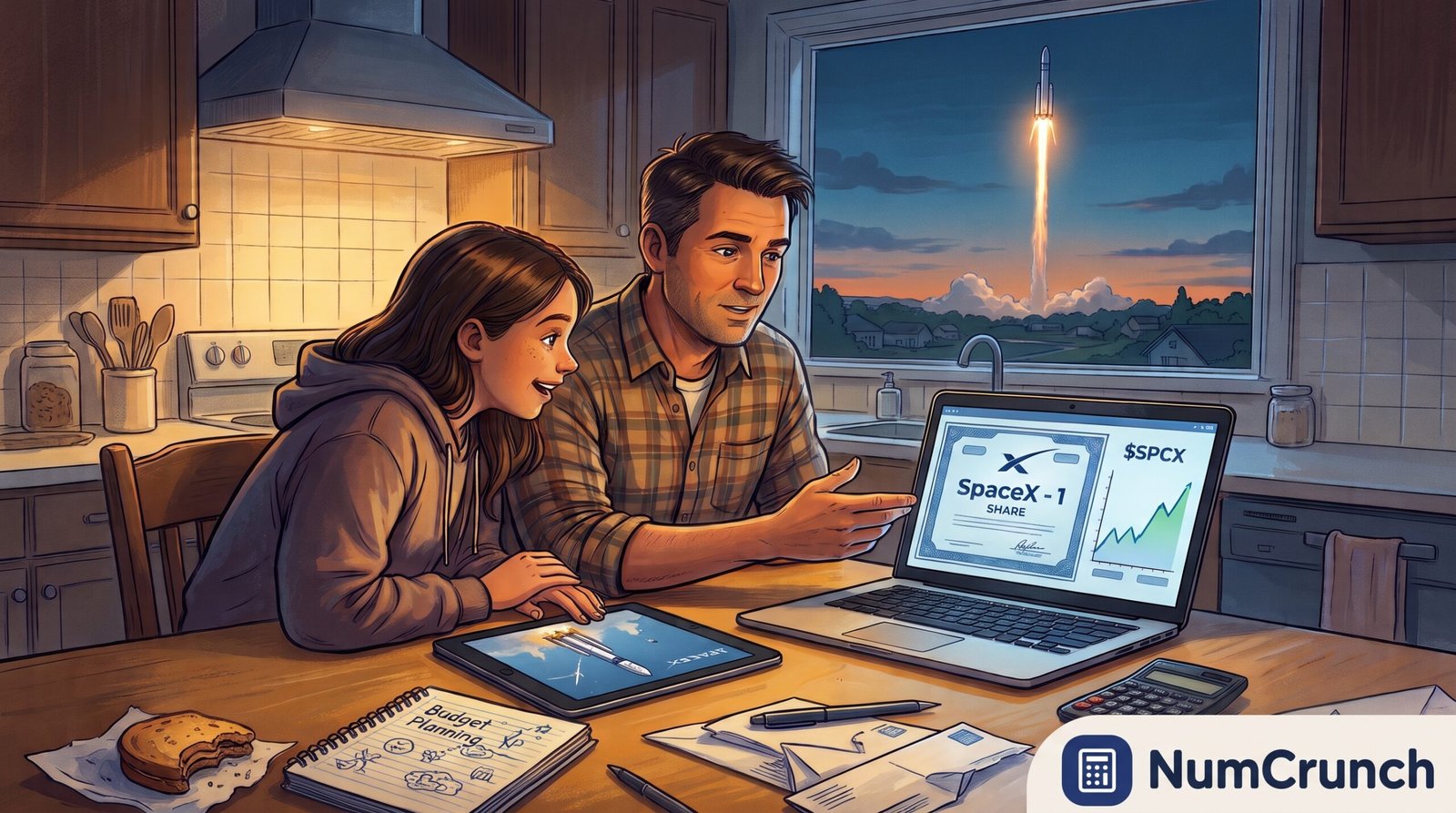
When Elon Musk took to X a few days ago and announced that he plans to give one share of SpaceX stock to every child in America next year, my immediate dad-brain reaction was instant:
“So cool! Way to go, Elon!”
Think about the sheer scale of that gesture. There are roughly 72 million kids under the age of 18 in the United States. Handing every single one of them an actual, certified piece of a private space exploration company that is landing rockets on barges and shooting for Mars sounds like something plucked straight out of a golden-age sci-fi novel. It’s bold, it’s futuristic, and on the surface, it feels wildly generous.
Then, about forty-five seconds later, the emotional dust settled. The spreadsheet in my head booted up, and the skeptic dad cleared his throat:
“Wait a second… what real good is one share of stock actually going to do?”
The Practical Reality Check
Let’s run the basic math.
With SpaceX trading around the $150 mark, this isn’t chump change. In the real world, $150 buys a solid pair of basketball shoes, covers a couple of weeks of groceries, or funds a great family birthday outing. It’s real cash.
As a standalone investment portfolio, however, it’s a puddle.
Even if you take the most wildly optimistic scenario—say the company pulls off an incredible 10X run over the next decade—you’re looking at $1,500. Skeptics will quickly argue that a multi-trillion-dollar valuation makes another 10X nearly impossible (though to be fair, critics said the exact same thing when Apple first crossed $1 trillion, and look where they are now). But even if SpaceX somehow defies the law of large numbers, $1,500 doesn’t pay for four years of college. It doesn’t put anyone on easy street, and it certainly won’t buy a reliable used car. It buys a laptop and a semester’s worth of textbooks.
Then there’s the red tape. A ten-year-old can’t just open an app on their phone and start trading equities. These shares require custodial setups—like the newly introduced federal accounts or traditional UTMAs. The grim reality? Early data shows that when custodial accounts are set up automatically, fewer than 1% of parents ever bother to claim and activate them.
Without parent involvement, tens of millions of these promised shares risk sitting completely abandoned in bureaucratic purgatory.
So was this just an $11 billion headline meant to break the internet while changing virtually nothing for everyday families?
The Spark: “The First of Many”
Before writing it off as a billionaire vanity project, look at the seven words Elon tacked onto the end of his announcement:
“This will be the first of many.”
That changes the entire conversation.
First, consider the corporate peer pressure. What happens if other corporate behemoths take the bait? Imagine a world where Microsoft, Apple, or Google feel compelled to match the challenge, handing American kids an initial starter basket of foundational companies. Suddenly, that solitary share turns into an actual diversified bedrock.
Second, it turns the mirror right back onto us as parents. If an eccentric tech CEO is willing to hand your kid a $150 financial seed out of nowhere, what is stopping you from matching it? What is stopping you from tucking away a share of an S&P 500 index fund on their next birthday instead of buying another plastic toy destined for the garage shelf?
The Real Crisis: The Financial Education Vacuum
The biggest argument for Elon’s giveaway isn’t the dollar figure. It’s the fact that our culture does an abysmal job of teaching kids how wealth actually works.
Our school systems will spend twelve years teaching our kids how to find the hypotenuse of a right triangle, how to label every organ of an earthworm, and how to memorize the dates of the War of 1812. Yet the vast majority of American high schoolers graduate without ever learning:
- What a stock actually is.
- How a brokerage account works.
- The staggering math behind compound growth.
- The difference between earning money and owning equity.
Most kids enter adulthood knowing only one financial identity: The Consumer.
They earn a dollar at a summer job, and their immediate instinct is to trade that dollar for a product, a subscription, or a meal. They understand how to give companies their money; they have no earthly idea how to take a piece of the company’s profit in return.
And let’s be honest: parents often avoid the subject entirely because the financial system feels complicated, opaque, and intimidating.
Elon’s stunt, if nothing else, serves as an undeniable battering ram against that inertia. A physical or digital notification arriving in the mail saying, “Your child has been gifted one share of SpaceX,” is an unavoidable conversation starter. It forces parents to look up what a custodial account is, log into a dashboard, and explain to their kid what just landed in their name.
The True Dividend: The Owner Mindset
The ultimate value of that single $150 share isn’t what you can sell it for at age eighteen. It’s the profound psychological flip from Consumer to Owner.
When that share is sitting in an account with your child’s name on it, their perspective shifts:
- Tangible Connection: When a Starship rocket clears the launchpad or a booster touches down on a floating platform, they aren’t just scrolling past an algorithm-fed video clip. They own a microscopic slice of the heat shield, the engines, and the satellite constellation in low Earth orbit.
- Demystifying the Market: A ticker symbol on a screen stops being abstract Wall Street noise. It represents a real company with real factories, real employees, and real revenue.
- Low-Stakes Volatility Training: Markets don’t go up in a straight line. Watching that $150 share fluctuate up to $180, down to $120, and back to $200 provides a masterclass in market patience. Learning that lesson with a single gifted share at age twelve prevents panic-selling a 401(k) at age thirty-five.
The Dad’s Money Tips Takeaway
One share of stock will not make your child rich. It won’t cover their tuition, and it won’t buy their first set of wheels.
If parents simply ignore the notification and let the share sit dormant, it will end up as nothing more than a funny trivia question on a future tax return.
But if you use that $150 ticket to crack open the door to investing, it could alter the financial trajectory of an entire generation. It plants the seed of ownership in minds that have only ever been trained to consume.
Your Dad Challenge for the Weekend:
Don’t wait around for Elon’s paperwork to arrive in the mail. Sit down with your teenager or pre-teen this weekend. Pull up a company whose products they use every single day—whether it’s Apple, Nike, or Sony. Open up a basic stock chart, show them the ticker symbol, and explain the difference between buying the shoes and owning the company that makes them.
You don’t need a billionaire to hand your kid their first lesson in building wealth. That privilege belongs to you.
——————————
Disclaimer: Look, I’m your internet Dad, not your personal financial advisor, certified public accountant, or family law attorney. The information in this blog post is for educational, entertainment, and general informational purposes only. It should not be taken as legal or professional financial advice. Because laws vary wildly by state and individual situations get messy fast, always consult with a qualified professional before making major life, financial, or legal decisions.
In the spirit of complete transparency, while the financial lessons and editorial direction of this post are entirely mine, the final text and accompanying artwork were crafted with the guidance and use of artificial intelligence. Play it smart, protect your assets, and keep crunching those numbers safely!